Home care is one of the fastest-growing sectors in the U.S. The Bureau of Labor Statistics projects that home health and personal care aide positions will grow 22% between 2022 and 2032, adding more than 700,000 new jobs each year. That growth is pushing agencies to hire caregivers quickly, especially as client demand rises, resulting in an increased need for open shifts to be filled. Moving too quickly, however, can lead to missed screening steps, inconsistent hiring practices, and delays later in the onboarding process.
The right screening process will depend on the position, location, applicable requirements, and agency policy. A companion caregiver, a driver, and a licensed healthcare professional may not require the same searches. The goal, therefore, is not to order every available background check for every applicant. It is to select the appropriate screening components for the role and apply the process consistently. A background screening checklist helps agency owners, HR managers, compliance teams, and hiring coordinators follow a consistent process while hiring and assigning a new employee to clients.
Why Should Home Care Agencies Use a Screening Checklist?
Home care employees often work inside clients’ homes with limited direct supervision. Depending on their responsibilities, they may provide personal care, transport clients, manage sensitive information, or support older adults and people with disabilities. The stakes are real: elder financial abuse costs older Americans a collective $28 billion annually, according to the National Council on Aging, and background screening gaps are one contributing factor.
A checklist can help an agency:
- Apply consistent screening procedures for similar positions
- Reduce missed or incomplete screening steps
- Document what was completed
- Select searches based on job responsibilities
- Identify unresolved results before placement
- Standardize hiring across multiple offices
A checklist does not make the hiring decision for the agency. It empowers the hiring team to standardize the collection and review of candidate information to ensure that hiring decisions align with established policies.
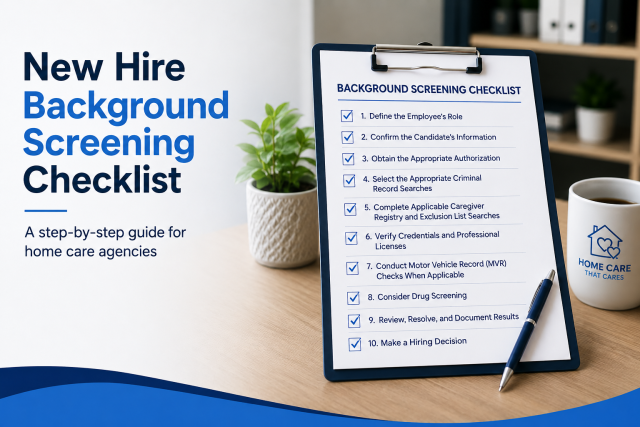
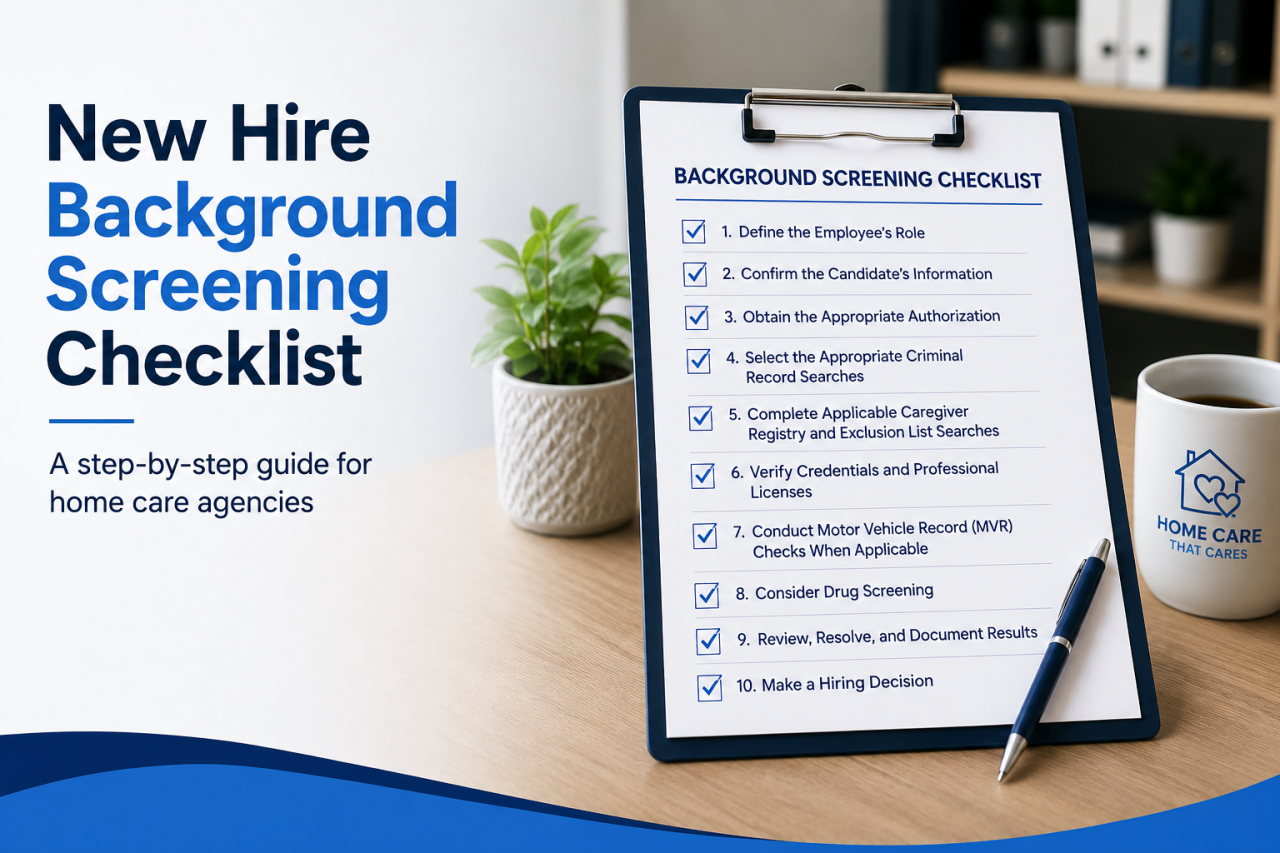
1. Define the Employee’s Role
Begin by documenting what the employee will actually do.
Consider whether the new hire will:
- Provide companionship or personal care
- Drive clients or operate an agency vehicle
- Handle money or private information
- Work with vulnerable adults or children
- Hold a professional license or certification
- Work in more than one state or service area
Defining the role first helps the agency avoid a one-size-fits-all screening approach.
2. Confirm the Candidate’s Information
Accurate information is essential for a reliable screening process.
Before ordering a report, confirm the candidate’s:
- Full legal name
- Previous names or aliases
- Date of birth
- Social Security number
- Current and previous addresses
- Driver’s license information, when relevant
Identity-related searches and residential history may help identify names and jurisdictions connected to candidates. They are used to guide additional searches rather than replace criminal record checks.
3. Obtain the Appropriate Authorization
When an employer uses a third-party background screening provider, disclosure and authorization requirements may apply.
Before ordering a report, the agency should follow its established process for providing required notices, obtaining written authorization, and retaining appropriate documentation.
Because requirements can vary by state and locality, home care agencies should work with qualified legal counsel when developing screening forms and employment procedures.
4. Select the Appropriate Criminal Record Searches
A more comprehensive screening solution often includes more than one type of criminal record search.
A national criminal database search can provide broad coverage, but it does not include every court or record source. Depending on the role, candidate history, location, and agency policy, additional searches commonly include:
- County criminal record searches
- Statewide criminal record searches
- Federal criminal record searches
- Searches in jurisdictions connected to address history
Layering searches can provide greater clarity, but not every search will be appropriate for every position.
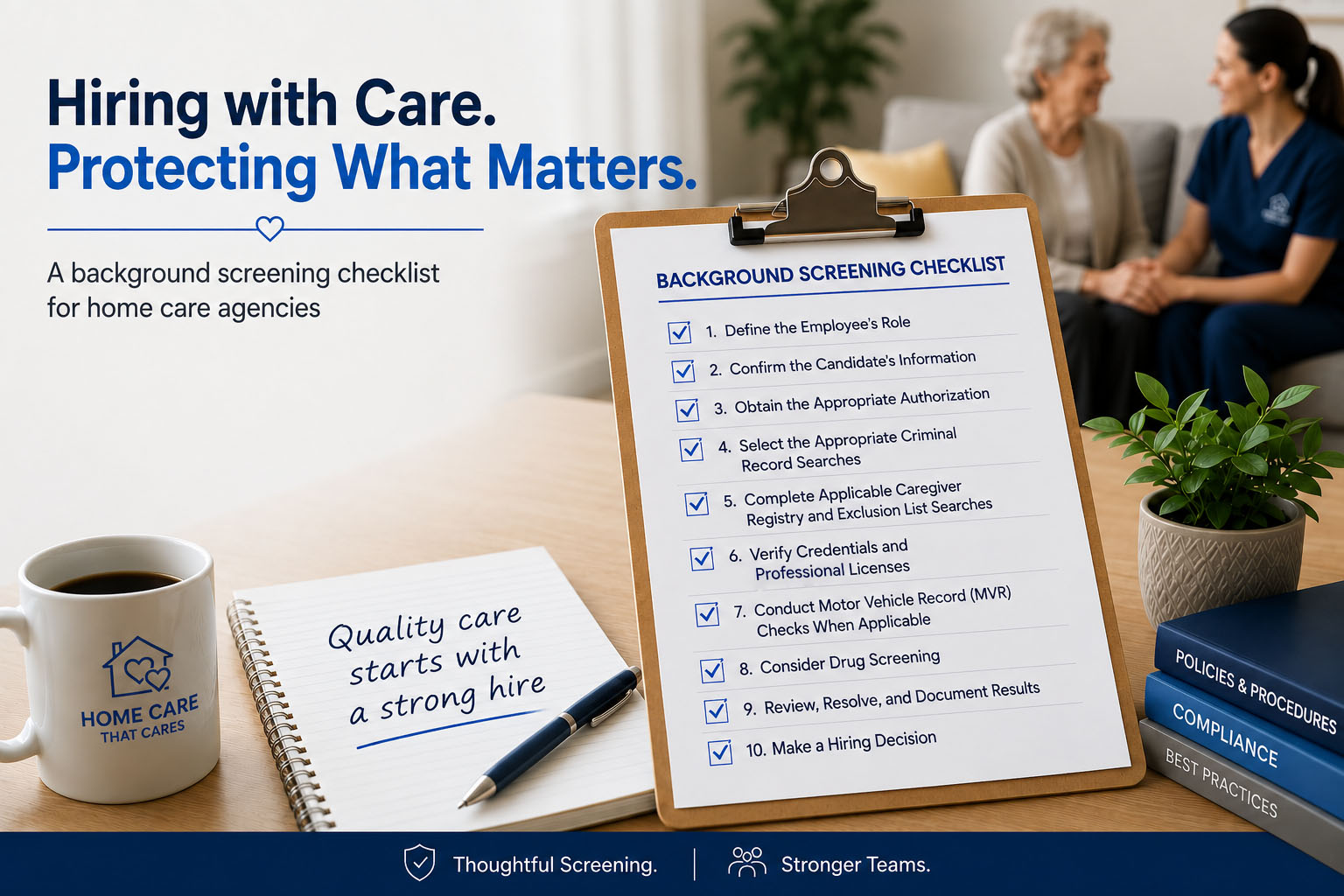
5. Complete Applicable Caregiver Registry and Exclusion List Searches
Home care agencies are often required to cross-reference specialized registries related to caregiver eligibility, history of abuse or neglect, or record of professional discipline or disqualification.
Depending on the agency’s services and location, these may include:
- Nurse aide or caregiver registries
- Abuse or neglect registries
- Employee disqualification lists
- Sex offender registries
- State healthcare worker registries
- OIG or other government exclusion lists
Requirements vary by state, position, payer source, and service type. Agencies should confirm which searches apply to their organization.
6. Verify Licenses, Credentials, and Experience
If a position requires a professional license, certification, degree, or prior experience, the agency should verify that information before placement.
Verification typically includes:
- Professional license status
- Certification type and expiration date
- Previous employment dates and job title
- Education or training credentials
These checks should be selected based on the qualifications required for the position. Allied Screening’s license, employment, and education verification services can help agencies confirm credentials efficiently.
7. Review Driving Records When Transportation Is Required
If a caregiver will drive clients or operate an agency vehicle, an MVR (driving record) check is typically appropriate.
A driving record may include information about:
- License status
- License class
- Expiration date
- Reported violations
- Suspensions or revocations
The agency should define which roles require driving-record checks and how often those records should be reviewed.
8. Complete Drug Screening When Applicable
Drug screening is often required based on the position, agency policy, client contracts, insurance requirements, and applicable state and federal laws. Common reasons for drug screening include:
- Client contracts or payer agreements that require drug-free workplace compliance
- Insurance or liability requirements tied to caregiver placement
- State licensing or certification requirements for the role
- Positions involving driving, medication administration, or other safety-sensitive responsibilities
Because drug-testing requirements vary by state, contract, and funding source, agencies should establish these procedures – including panel type, timing, and consequences for a positive result – with qualified legal and compliance guidance.
9. Review the Report Consistently
Once the screening is complete, confirm that:
- The report belongs to the correct candidate
- All requested searches are complete
- Potential records have been properly matched
- Licenses or credentials have been verified
- Unresolved results have been addressed
- The report has been reviewed under the agency’s written policy
- The final decision has been documented
The screening provider supplies information. The employer remains responsible for reviewing the report and making the hiring decision.
10. Follow the Agency’s Established Hiring Procedures
When information in a consumer report may affect an employment decision, specific candidate notification and review procedures may apply.
The agency should follow its established policies and seek qualified legal guidance regarding applicable pre-adverse action, adverse action, dispute, and individualized review requirements.
Allied Screening provides background screening services and educational resources, but it does not provide legal advice or make hiring decisions for employers.
Quick Screening Checklist
Before placing a new caregiver with clients, confirm that your agency has:
- Defined the position and job responsibilities
- Selected a screening package appropriate for the role
- Confirmed the candidate’s identifying information
- Obtained the required authorization
- Completed appropriate criminal record searches
- Completed applicable registry and exclusion list searches
- Verified required licenses or credentials
- Reviewed driving records when transportation is involved
- Completed drug screening when applicable
- Reviewed all results under agency policy
- Documented the final hiring decision
Establish a Consistent Screening Process
Background screening is most effective when it is based on the position, documented in agency policy, and applied consistently – and often, these factors mean a combined screening solution is most appropriate. A national database search may be one useful part of the process, but it may not provide every record or verification an agency needs. Depending on the role and location, a more comprehensive solution typically includes county searches, registry checks, exclusion searches, license verification, driving records, and possible other screening components.
Allied Screening works with home care organizations to offer background screening solutions built around their positions, locations, hiring processes, and operational needs. Our team helps employers understand the available search options and build screening packages that support a more organized hiring process.
Need help building a screening package for your home care hires? Contact Allied Screening to discuss your positions, locations, and screening needs.
Note: This article is provided for general educational purposes only and is not legal advice. Screening requirements vary by jurisdiction, position, employer, service type, contracts, and other circumstances. Home care agencies should consult qualified legal counsel regarding their screening policies and compliance obligations.